Eigendecomposition Signal/Noise Threshold
Procedures that perform an eigendecomposition, either for data reconstruction or solving for parametric coefficients, offer the means to graphically select the number of eigenmodes that are to be included in the signal space. The retained eigenmodes should represent the signal or principal components since these are used for the procedure's solution or reconstruction. The discarded eigenmodes should represent the noise since this information is zeroed and does not factor into the solution. This signal-noise separation is intrinsic to SVD procedures.
When a sufficient matrix order exists to effect this signal-noise separation, and provided signal strengths and properties are such that an eigendecomposition can isolate signal components, the singular value or eigenvalue plot will reveal a threshold that reveals a clear demarcation between signal and noise. The eigenvalues or singular values usually require a log scale in order to perceive this transition. Since the singular values are the square root of the eigenvalues, the eigenvalues will show a greater separation in relative magnitude.
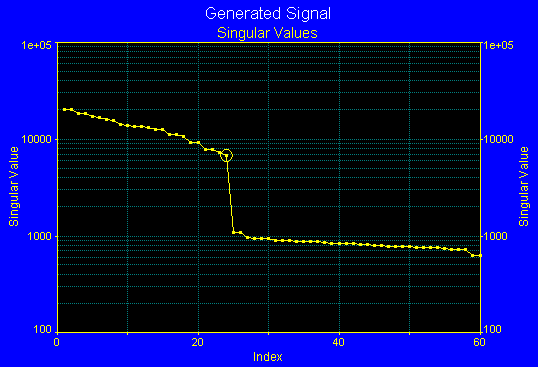
To select the optimum signal space, left click the mouse on the last eigenvalue or singular value that represents signal. This eigenmode and all prior ones will be processed while all subsequent singular values will be zeroed. The example below contain 12 sinusoids and white noise. With an AR model order of 60, the Data SVD FB procedure produces the following signal-noise threshold. Since two eigenmodes are needed to catch each oscillatory signal component, 24 singular values are needed to fully capture the signal. The selected point is the 24th eigenmode and the transition is clean.
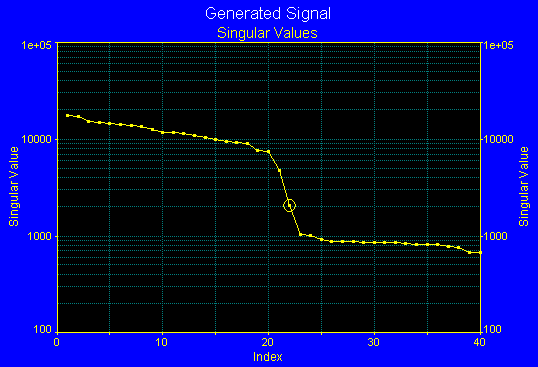
The only harm in fitting very high orders with SVD is the increased processing time. In general, you need to strike a balance between SVD processing time and model order. With SVD, you must choose a high enough model order to threshold the signal and noise effectively. A transition, of itself, is not an indicator of a sufficient model order. The singular value plot below is for this same example, except that an AR model order of 40 was used. Note the two eigenmodes that occur in the transition band. Here the 22nd eigenmode represents the last signal element before the noise floor. The model order is insufficient.
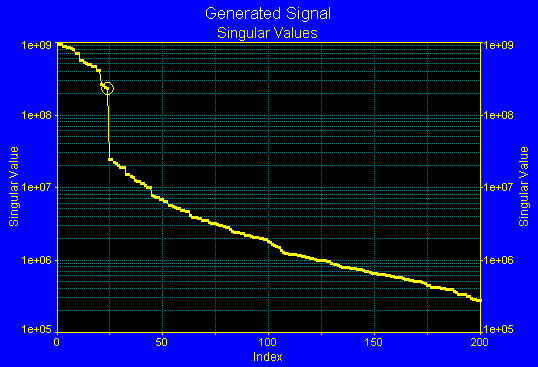
If you can tolerate the processing time and have sufficient free memory available, a very high order can be safely used. The higher the order, the more complete the signal-noise thresholding can be. The Eigendecomposition options can use a square covariance matrix which readily supports processing large data sets with high model orders. Similarly, the AR procedure offers SVD normal equations algorithms which are appreciably faster with large data sets than processing the full data matrix. The following singular value plot is for a 200th model order Nrml SVD FB AR fit.
White (Gaussian distributed) noise is most easily thresholded using SVD. Red noise, which decreases in power as frequency increases, is not as readily partitioned using the SVD. Also, bear in mind that all eigendecomposition procedures partition based upon signal strength. When noise is present at levels that start to approach that of the signal, the characteristic transition may be impossible to achieve. Fitting the highest order for a given algorithm is one way to confirm whether or not this signal-noise transition can be achieved.