Chebyshev Series Equations
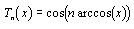
Chebyshev functions are designated Tn(x) and are defined from x=-1 to 1. These functions evaluate to the same narrow range of -1 to 1. Formally, the Chebyshev function of degree n is defined by:
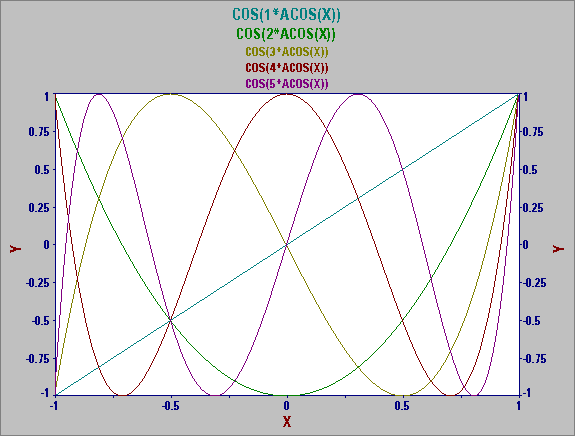
A recursion formula exists:

As such, the following expressions describe the Chebyshev series terms used in TableCurve 2D:
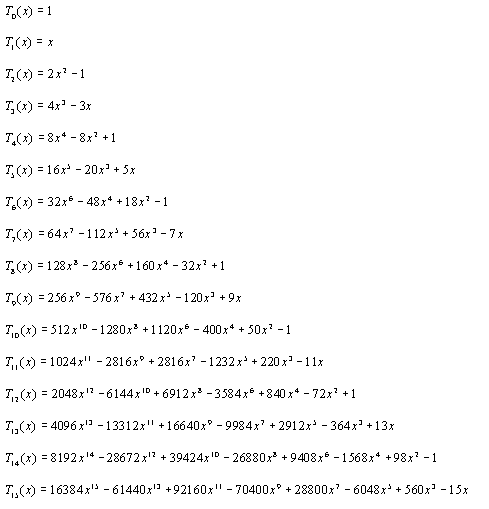
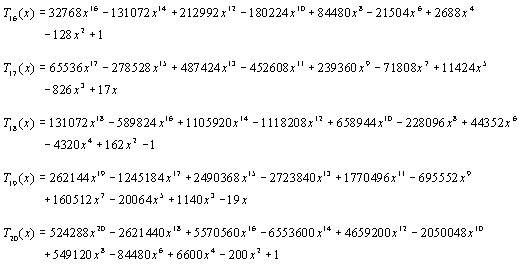
The new TableCurve 2D Chebyshev equations are as follows:
Polynomials: 3rd order through 20th order, Equations 6803-6820
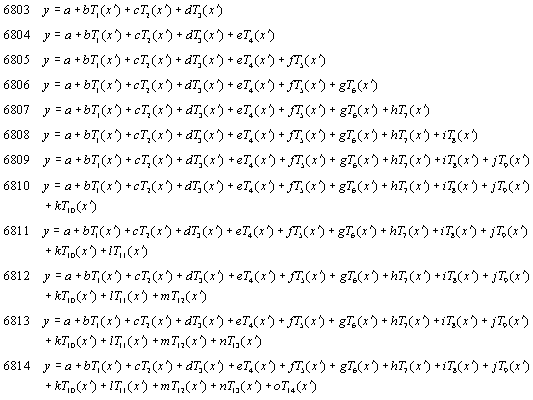
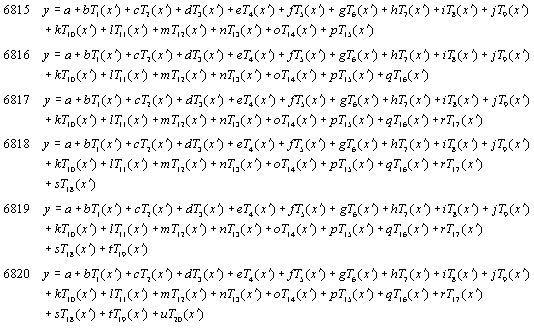
*Rationals: 2/2 order through 10/10 order, Equations 7604-7620*
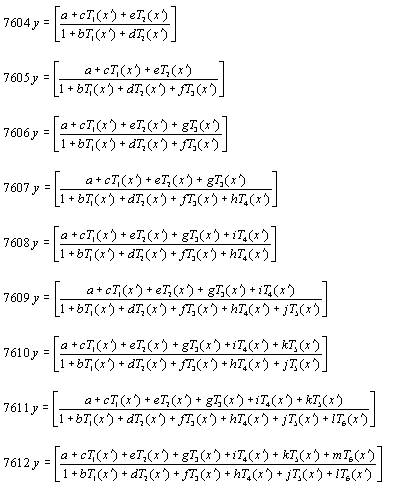
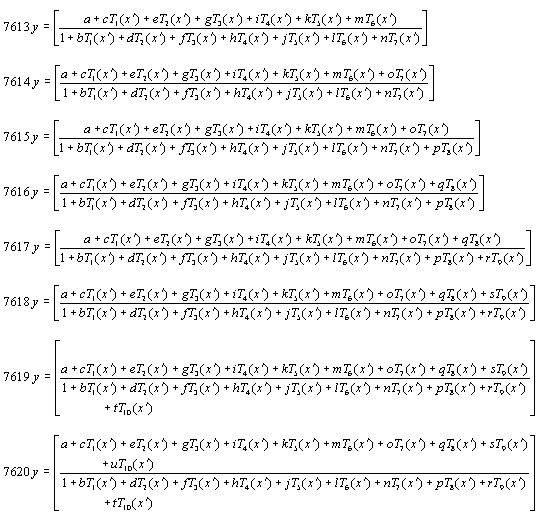
The x' represents the mapping of x to the range of -1 to 1.
A Chebyshev polynomial or rational tends to produce a highly stable matrix inverse. For practical purposes, ill-conditioning does not exist. This makes it possible for TC2D to offer Chebyshev polynomials through 20th order and rationals through 10th/10th order using the 80-bit precision of the Intel hardware floating point.
These equations are evaluated using the recurrence relation, which is quite efficient, although in general you should expect a Chebyshev polynomial or rational evaluation to require about twice the time required for a standard polynomial or rational of the same coefficient count.
Because Chebyshev models are too complex to code in-line, each of the code generation languages uses a separate function to map the range and perform the evaluation.
It is often desirable, though not always wise, to convert a Chebyshev polynomial or rational to a standard polynomial or rational representation. While the simpler form does result in a faster evaluation, there can be significant losses of precision within this conversion. For example, one might throw away the least significant half of the digits in the Chebyshev coefficients, and still find only a 1E-8 error as compared to an evaluation made using full precision. If one were to throw away the least significant half of the digits in the converted coefficients, the error could well be enormous.
If you choose to use converted forms of the Chebyshev models, it is strongly recommended that you use the Precision option in the Review to confirm that you can tolerate the resultant errors. Most code languages use 64-bit (15 digit) double precision. The drop from 80-bit (19-digit) precision to 64-bit may itself introduce an undesirable amount of error when working with converted coefficients.
The converted Chebyshev equations are as follows:
- Polynomials: 3rd order through 20th order, Equations 6853-6870
- *Rationals: 2/2 order through 10/10 order, Equations 7654-7670*
No confidence intervals are available for the converted equations since no inverse is available.