
Log-Normal 4-Parameter
The LogNorm4 is TableCurve's four-parameter log-normal peak: the asymmetric generalized normal written in the quantities read directly from a peak, its amplitude, the x of its maximum, its full width at half maximum and its asymmetry at half maximum. Its asymmetry is set independently of its width, and as the asymmetry approaches 1 the peak approaches a Gaussian.
Parameters
a Amplitude, the height of the maximum b Mode, the x of the maximum c FWHM, the full width at half maximum d Asym50, the asymmetry at half maximum: the right half-width over the left. A value of d above 1 tails to the right, below 1 to the left; d = 1 is the Gaussian limit and may not be used exactly.
Equations
8174 LogNorm4_ the peak above, no intercept 8175 LogNorm4 with a constant 8222 LogNorm4+ with a linear baseline 8583-8600 the two- and three-component LogNorm4 models, fitted when 2-Component Models / 3-Component Models are ticked with Log Normal-4P Built-in function: LOGNORM4_(a,b,c,d)
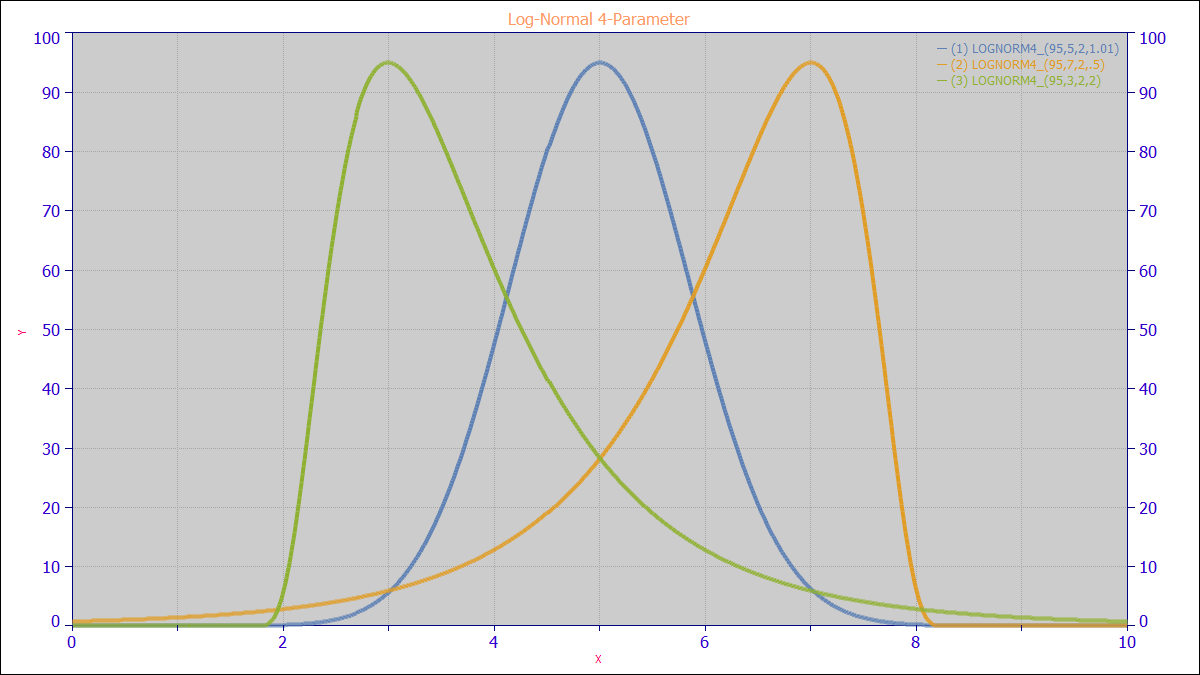
Three LogNorm4 peaks of amplitude 95 and FWHM 2: the asymmetry 2 tails to the right, 0.5 to the left, and 1.01 is all but a Gaussian.
Area
Support

The LogNorm4 exists on one side of x = b - cd/(dē-1) only: to the right of that point when d > 1, to the left when d < 1. Beyond it the peak is zero, which is also the value it approaches at that point. TableCurve evaluates it that way, and the code it generates for the LogNorm4 models reproduces it at every x with a LOGSAFE function (the natural logarithm where its argument is positive; log(1E-300) otherwise), so a fitted LogNorm4 never produces a math error outside its support. LogSafe(x) is also available in the parser.
The LogNorm4 Cumulative
The integral of the LogNorm4 is a full asymmetric transition family in its own right, with its own 2- and 3-component forms: see Log-Normal 4-Parameter Cumulative (LN4 Cumulative).
The Asymmetric Generalized Normal
The LogNorm4 is the only generalized normal among TableCurve 9's models. The family goes back to 1879. Francis Galton observed that many vital and social statistics are not distributed symmetrically about their arithmetic mean, and Donald McAlister, in the paper that followed Galton's, derived the log-normal law: a quantity whose logarithm is normally distributed. Shifted, and written in terms of a location, a scale and a shape, the log-normal becomes the three-parameter log-normal, which J.R.M. Hosking and J.R. Wallis call the generalized normal distribution. Its shape parameter sets the asymmetry, and a shape of zero is the normal (Gaussian) distribution itself. The LogNorm4 expresses that location, scale and shape as the mode, FWHM and Asym50 above.
Siano and Metzler
This parameterization, by the position of the maximum, the height, the width at half height and an asymmetry measured at half height, was introduced by Donald B. Siano and David E. Metzler of the Department of Biochemistry and Biophysics, Iowa State University, Ames, Iowa. Fitting the structureless ultraviolet absorption bands of hydroxypyridine derivatives in solution, they showed that the log-normal gives a much better description of such bands than a Gaussian with two half-widths, that it resolves overlapping bands well by least squares, and they offered a simple configuration-coordinate model that lends the parameters physical meaning. In 1985 Carol M. Metzler and coworkers fitted more than 160 electronic absorption spectra of over 95 compounds with these curves and found them widely applicable. The name 4-parameter log-normal (LogNorm4) honors this work.
References
F. Galton, "The Geometric Mean, in Vital and Social Statistics", Proceedings of the Royal Society of London, 29 (1879) 365-367.
D. McAlister, "The Law of the Geometric Mean", Proceedings of the Royal Society of London, 29 (1879) 367-376.
D.B. Siano and D.E. Metzler, "Band Shapes of the Electronic Spectra of Complex Molecules", Journal of Chemical Physics, 51 (1969) 1856-1861.
C.M. Metzler, A.E. Cahill, S. Petty, D.E. Metzler and L. Lang, "The Widespread Applicability of Lognormal Curves for the Description of Absorption Spectra", Applied Spectroscopy, 39 (1985) 333-339.
J.R.M. Hosking and J.R. Wallis, Regional Frequency Analysis: An Approach Based on L-Moments, Cambridge University Press, Cambridge, 1997.