
PeakLab v2 Documentation Contents R2N Software Home R2N Software Support
G2AMG
Gaussian Convolved with Sum of Two Half-Gaussians, Area Weighted
a0 = Area
a1 = Center (as mean of Gaussian peak that is convolved by the sum of half-Gaussian and exponential)
a2 = Width (SD of the Gaussian peak that is convolved by the sum of half-Gaussian and exponential)
a3 = The narrow width probabilisitic half-Gaussian SD in the convolution (must be positive, right-sided convolution)
a4 = The larger width probabilisitic half-Gaussian SD in the convolution (must be positive, right-sided convolution)
a5 = The area fraction of the narrow component
Built in model: G2AMG
User-defined peaks and view functions: G2AMG(x,a0,a1,a2,a3,a4,a5)
The G2AMG model is the convolution of a Gaussian and <g2> IRF (area weighted sum of half-Gaussian delays). The G2AMG can also be written as the Gauss<g2> convolution. Unlike the generalized chromatographic models that address nonlinear tailing and fronting and higher moment non-ideality, the G2AMG convolution integral has a closed form, easily computed, solution as shown above.
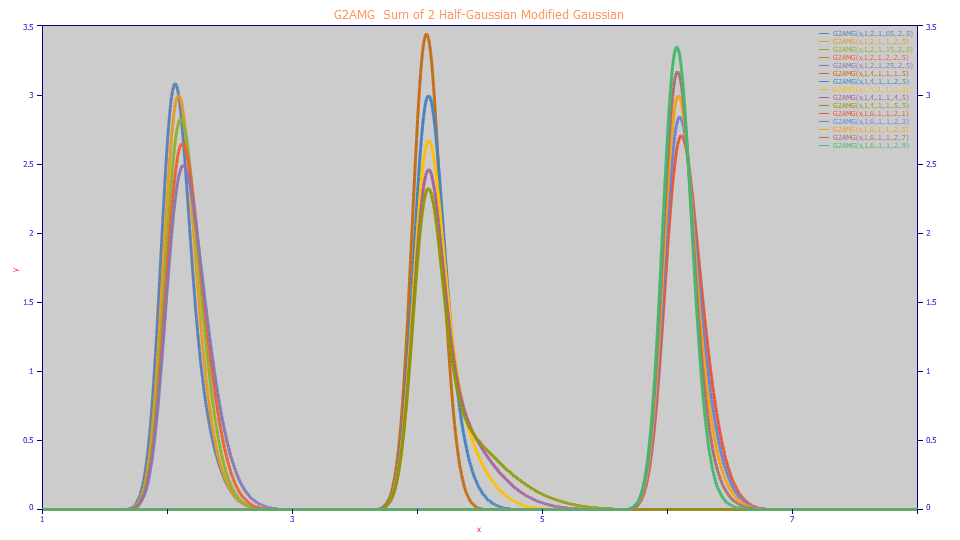
In the first series of peaks the narrow Gaussian's SD is varied. In the second series, the wider Gaussian's SD is varied. The slower kinetic component will produce the greater attenuation of the peak amplitude and it will produce most of the right-side tailing. The third series varies the area fraction of the two components, each held constant in their widths.
Two-Component IRF with Closed-Form Solution
Chromatographic IRFs tend to have a slow component, fitted by this exponential, and a fast component which can be fit with a narrow width half-Gaussian or fast kinetic delay. The E2AMG is important since it offers a Gaussian peak with a two-component IRF in a closed-form solution.
Theoretical Foundations for G2AMG Model
This is the closed-form model to which the once-generalized GenHVL[Z]<g2> simplifies if the a3 chromatographic distortion in the GenHVL[Z]<g2> is effectively zero (the chromatography is purely in the linear regime of concentration) and if the a4 third-moment asymmetry in the GenHVL[Z]<g2> is also effectively zero (a symmetric peak is observed in the separation independent of the IRF).
The twice-generalized GenHVL[Y]<g2> similarly simplifies to the G2AMG if the chromatographic distortion is zero, the asymmetry is zero, and the GenHVL[Y]<g2> model's fourth moment power of decay is 2.0, a Gaussian.
The GenNorm<g2>simplifies to the G2AMG if the asymmetry in the GenNorm<g2> is effectively zero (a symmetric peak is observed in the separation).
Similarly, the GenError<g2> simplifies to the G2AMG if the asymmetry in the GenError<g2> is zero, and the GenError<e2> model's fourth moment power of decay is 2.0, a Gaussian.
Right-Skewed Shapes Only
In PeakLab, the G2AMG is treated as the Gauss<g2> convolution model where the a3-a5 'g2' parameters are the IRF parameters.
The more complex, non-closed form, theoretical chromatographic models address the concentration-dependent non-linear tailing and fronting, as well as higher moment non idealities in the separation that introduce both left and right skewed shapes. Since there are far more effective models to manage fronted and left-skewed peak shapes, the G2AMG is constrained to functioning as a Gauss<g2> model that treats the two components of the convolution as instrumental distortions adding right skew to the peak shape.
We thus treat the G2AMG as a theoretical model for chromatography where the core column peak is Gaussian, and the IRF consists of the sum of two kinetic components. This means the G2AMG can only fit right-skewed shapes.
By contrast, the EMG and GMG models in PeakLab were historically used as empirical models for both left and right skewed shapes, and those models will fit left skewed shapes using a negative time constant or negative SD. The G2AMG model, as implemented in PeakLab, cannot be used a general empirical model that manages left skewed peaks.
Chromatographic Separations
This model should be deemed experimental. A Gaussian's decay is approximately that of a catalyzed kinetic order close to 0.6. Since LC generally has order 1 kinetic delays in the fluid flow path, this model has rarely been found useful with real-world chromatographic data. One exception was with an experimental detector that added high measure of one-sided Gaussian distortion to the signal.